
The Secret Code of Schoolchildren
Childhood is a culture and a language.

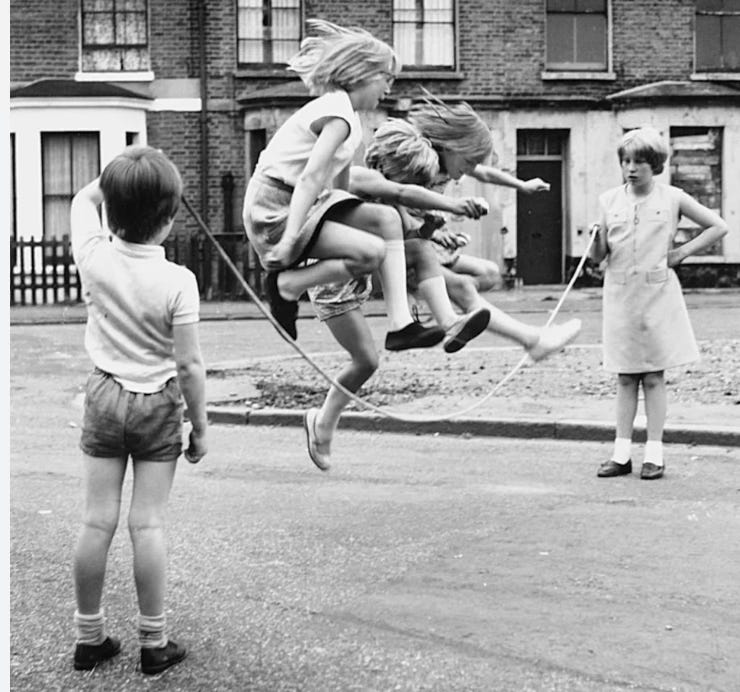
I once saw my eldest daughter teaching my youngest daughter a clapping song –‘Miss Mary Mack, Mack, Mack/All dressed in black, black, black/With silver buttons, buttons, buttons/All down her back, back, back.’ This song was taught to her by her mother. She, presumably, was taught it either by her own mother or by her school friends.
This rhyme, I later discovered, stretches back to the American civil war. It then struck me that childhood is not only a situation in time,but a whole culture, a historical dynamic, from which adults are largely excluded, except as slightly puzzled observers.
There is a wonderful book about this subject I happened upon in an Oxfam shop recently, called ‘ ‘The Lore and Language of Schoolchildren’, first published in 1959 by Iona and Peter Opie. ‘Miss Mary Mack’does not appear in it, but what is extraordinary is that many of the games and codes employed by children 50 years ago had pre-existed the book for many scores of years –and that many of them continue still now. This isn’t only true of obviously ancient examples of rhymes and songs –like ‘Ring a Ring A Roses’ and ‘London Bridge is Falling Down’. It also applies to social injunctions, taboos and invocations.For instance declaring a truce when playing a game was for me the utterance ‘vainites’. This has been replaced for my children by ‘homey’ or ‘time out’. But ‘vainites’ (or ‘fainites’) itself is doubtless still being used in many parts of Britain as it was in 1959. ‘Olly Ollyee’ was the truce code in Portsmouth, and I remember David Mamet writing of the call of ‘Olly Olly oxen free’ at evening in Chicago.
The culture of children is sometime an Esperanto, crossing continents.I was surprised by the depth and range of these childhoodcodes.The Opie book contains sections on ’Parody and Impropriety’ ‘The Child and Authority’ ‘Jeers and Torments’ and ‘Half Beliefs’ (or superstitions) such as ‘step on a beetle/it will rain/pick it up and bury it/the sun will shine again’ (Swansea).
Many of these superstitions still endure –for instance the danger of treading on cracks in the pavement (ifyou tread on a crack, or tread on a spout/It’s a sure thing your mother will turn you out). There is a whole section about the child-folklore of‘Lines onPavements’. Nowadays, Charlie and Lola warn children against ‘pavement bears’. I recently heard children chanting ‘See a penny pick it up, then all day you’ll have good luck’. A century and a half a go, children in America were singing ‘See a pin and pick it up/then all day you’ll have good luck’)
This book came as a revelation, because I realized that children do not only exist in our culture –the one defined by their parents and the wider society –but their own, if you like, counter culture, inherited and inflected across the regions and down the ages, a system that involves taboos, punishments and a rough system of justice.
Transgressions, for instance, may be punished with a ‘Chinese Burn’ which were being handed out when I was a kid -knownin the US as an ‘Indian Burn’ -which involves twisting your hands hard round someone’s wrist.In the section on ‘Tortures’ (!) it mentions hair pulling, the ‘barley sugar’ (twisting the arm)and of course that birthday treat, the bumps. So next time you tell your children to stop being so mean singing ‘ see my finger/see my thumb/see my fist/you’d better run’, you should be aware that you are imposing your cultural values on a long established and venerable system of codes and signals. I think of it as ‘sugar rush Sharia’ -softer, but ancientand self-perpetuating witha dynamic, a justice system, a system of punishments, as well as a language and a logic of all of its own.
This article was originally published in The Guardian.
Beautiful!