
On Non-Duality
Why 2 into 1 Won't Go

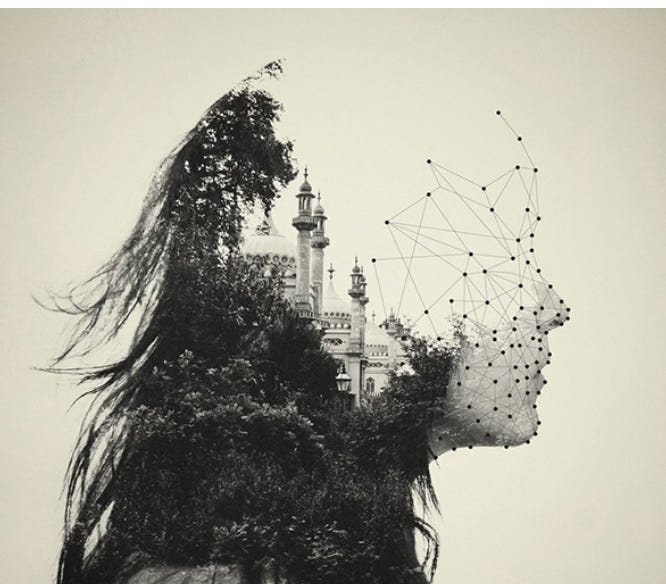
In September I wrote on this site about my visit to a spiritual retreat in Hydra, Greece, where I was taught about the concept of non-duality.
What is non duality? Once I looked into it I realised there was a whole ecosystem of books and lectures on the subject, often dressed up in different clothes - as Buddhism, or Vedanta, or Taoism, or Hinduism. There are even traces of it in Christianity, and you can also find it - in effect - in neuroscience, since brains scans can’t reveal a ‘self’.
Non-duality stands against the idea that we’re are essentially split as human beings, either internally or externally. In Duality, there a good ‘I’ - the rational, moral self - and a bad ‘me’, the instinctive, more driven part of ourselves. The rational moral self is fizzing with concepts, thoughts and judgements while the other parts of ourselves are either brute animal energy or nothing at all.
Many thinkers have tried to separate the mind into parts, beginning with Plato, who thought the mind had a rational, spirited and appetitive parts and Socrates believed in a self that could exercise moral judgement and self control. Much later, Freud thought the mind could be broken down into the Ego ( the ‘I’ sensation) , Superego (the part of the self that makes moral judgements on the ego, a sort of self-righteous sports commentator) and the Id, or primitive unconscious. There are many other theories of mind, but you get the picture.
Non-duality does not split the mind in this way. It posits that the ‘watching ‘I’’ - the observer that stands back and seems to bear witness to our acts and thoughts and feelings - does not in fact exist, but is an illusion, created by movements in the self - rather as if when you rotate a light quickly, it seems to produce a visible circle. And once you correct the mind to experience reality in a non-dual way, you begin see that there are no separating ‘things’ in the universe, just a seamless, unbroken unity of which you are an inseparable part.
It’s not an easy idea to grasp, but then, it’s not an idea to be grasped. It’s a reality to be experienced directly. As such, you can think about it as much as you like, but it won’t take you any closer to awakening from the dream of self. You can only wake up and see that ‘you’ are not ‘real’, but simply a construction of your memories, accumulated experiences and enculturation. For non-dualists, there is only This , i.e., moment by moment experience itself. You are not your thoughts and there is no ‘doer’ who decides on actions.
Meditation helps you to get in touch with this reality, but it does not explain it to you. There’s nothing that can be explained because existence is a mystery. You can no more say what existence is than explain music to someone who has never heard it, or colour to someone blind from birth. As for myself I have never experienced the moment of ‘awakening’ when I realise that I am ‘one with everything’, and I doubt in truth that I ever shall (except perhaps when I have taken a few magic mushrooms). But I live in hope.
More usefully, in non duality, you are taught not to believe in your thoughts - which in some ways makes it very close to stoicism, Buddhism or even CBT. The mind is seen a chattering mechanism, full of delusions and junk mixed in with thoughts that may or may not be true. This goes against just about every canon of what we have been taught in the West, since our automatic tendency is to believe we are our thoughts. Take them away and there’s nothing left, except a drooling moron.
Keep reading with a 7-day free trial
Subscribe to Tim Lott's Writing Boot Camp & Philosophy Jam to keep reading this post and get 7 days of free access to the full post archives.