
About Ancestors
Family Doesn't Stop At The Living

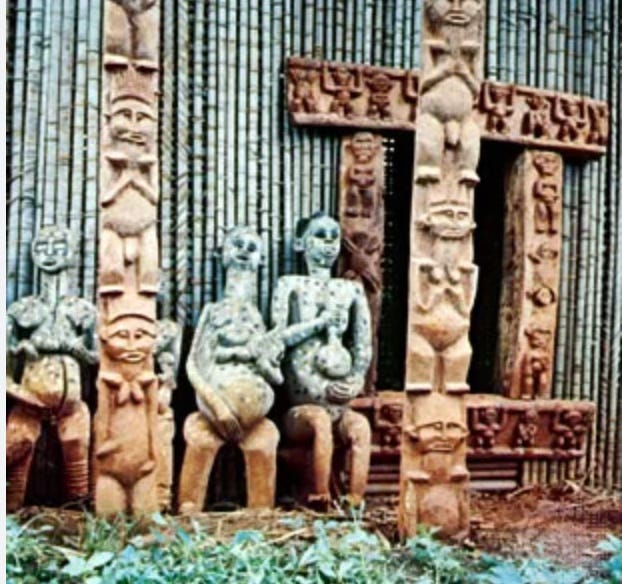
When we talk of ‘family’ it is customary in our culture to be talking exclusively about people who are alive. However, in this we may be the exception rather than the rule. Many cultures practice ancestor worship, and still more give a great deal of time honouring the departed members of their kin. But we burn them, bury them and forget them pretty quickly in comparison.
My mind took this turn after I visited the grave of my father. My father would have been indifferent to this visit such an English pragmatist was he (‘when you’re dead you’re dead’ was his philosophy of mortality), but I found contemplating the rugged rectangle of slate that marked the hole into which I had helped lower him oddly satisfying.I could not say wherein that satisfaction lay.
I knew that six foot under that spot was just a sprinkling of bones that had nothing to do with the living spirit I had known. And yet visit, I did, and pay tribute, I did, with a handful of wild flowers. This simple gesture is, of course, a shrunken version of ancestor worship – as are the family trees that adorn the walls of many families, and the faded black and white photos of grandparents that sit above the stairs (as they do in mine).
In acknowledging our dead relatives - only the grander social classes have ‘ancestors’ - we are marking ourselves out as part of a line, a line that in theoretical terms stretches back to the dawn of mankind, although we can identify only a very few most recent links in the chain.
I have sometimes asked of myself what my motivations were for writing my family memoir, ‘The Scent of Dried Roses’ that traced my own family back to the beginnings of the last century. The ostensible reason was an inquiry into the hereditary and sociological reasons for my mother’s suicide. But perhaps the deeper reason was that I wanted to feel part of something larger than myself. Our dead relatives – our ancestors – are part of the project in elevating us from anonymity and our own fates as soon-to-be dead relatives. They are exercises in identity, no less than protestations about gender and class and sexuality. They help locate us and elevate us above the scrabbling, mortal primates we actually are. They are part of a story in a web of stories, but they are a part that many of us have forgotten to honour.
As it happens I live close to one of the biggest graveyards in London, the ‘necropolis’ – literally, ‘city of the dead’ – of Kensal Green. I often walk among the fading tombstones, and I am struck by how unkempt and untended for so many of them are. Many recent internments feature trivia like beer cans and favourite cigarette brands and football regalia. Our honouring of the dead, whereit takes place, is now often reduced to a memorial to consumer and leisure habits.We cannot turn the clock back. We have lost interest, on the whole, in our dead relatives, as we continue the modern project of urgently denying death, and asserting (paradoxically) the supremacy of science and secularism, which leaves us nothing to mourn except a few decaying molecules rather than a repository of meaning.
As for me, I will insist when I peg out that I am planted in that cemetery with duereverence and gravity. Like all of us, I am destined to be an ancestor, and I wantto be one with some style – no old DVD boxes of ‘Breaking Bad’ for me thanks. Just a few simple flowers on my birthday – or deathday - and a little respect, so that I can carry out my posthumous job; to form a completed chapter in a never-ending story.
This article was originally published in The Guardian